He’d done it. He, Richard Nixon, had been in his new position since a couple of weeks by now. He’d fought tooth and nail in his campaign against the Democrats’ rapid succession of faces, from Lyndon Johnson, to Eugene McCarthy, the late Robert Kennedy, and finally Hubert Humphrey and their anti-war agenda. They were right about one thing though, Vietnam was a disaster and not showing any signs of good progress. In fact, he himself had based parts of his campaign on a secret plan to bring American intervention in the country to an end, with the trusty Henry Kissinger at his side.
As he rubbed his neck, he thought about what he planned to do that day. Nixon had also made other promises during his campaign. Since 1945, the United States and its polar opposite, the Soviet Union, were locked in a Cold War, and since 1957, one of the most pioneering pans of this War was the Space Race both countries were locked in. The commies had put the first satellite into orbit, the first man into orbit, et cetera. When one side did something, the other responded in kind. And one thing was for sure, the stars and stripes were headed to be first on the Moon since Kennedy’s choice of going to the Moon in 1962.
However well the Apollo program was going, it was certainly also a program whose life support was based on bettering the Soviets. There had been proposals for different ways to go forward, but none were truly organized. Hence one of the main things Nixon was going to do that day: calling upon his Vice-President, Spiro Agnew, to gather a Space Task Group. Nixon needed a report on how to proceed with Apollo and beyond by September of that year, and was eager to get to that date.
“…which is why I believe this is our best bet for the future.” George Mueller finished his presentation in the meeting room. Agnew was as eager as one gets in such a context, as he’d nodded profusely during the half-hour that Mueller had spoken. NASA Administrator Thomas Paine also seemed onboard with the idea. The Space Task Group had heard about Mueller’s “Integrated Program Plan” being thrown around, and finally heard what it was.
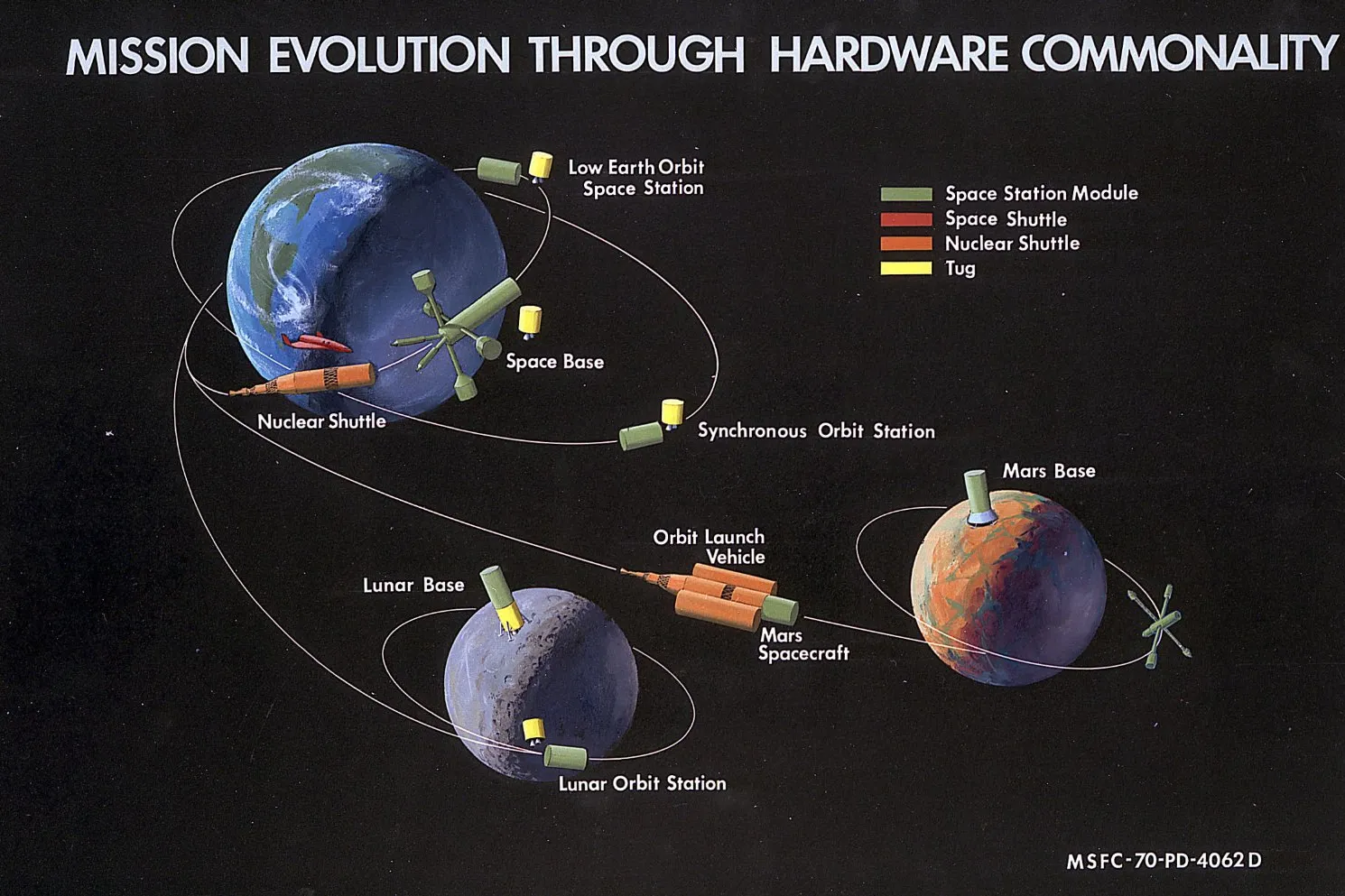
Mueller was the Director of the Office of Manned Space Flight, and the mind behind the concept of all-up testing which had, at least until now, brought the Apollo program so far. But Mueller had also been preaching about his integrated plan since a few months or so now, and finally the big paper pushers could hear about it. His grand idea of the future of American spaceflight, with a reusable “space shuttle” ferrying astronauts and cargo to orbit and back, space tugs and nuclear shuttles carrying things around to the Moon and maybe even to Mars? Finally, it was finally being considered, and seeing Agnew and Paine’s faces, there was a pretty good chance the IPP could deeply influence the STG’s final report.
“Engine arm is off,” Neil Armstrong said to his crewmate Buzz Aldrin, before contacting Charles Duke back on Earth, who was CAPCOM, “Houston, Tranquility Base here. The Eagle has landed.” Duke soon enthusiastically answered, “Roger, Twan—Tranquility, we copy you on the ground. You got a bunch of guys about to turn blue. We're breathing again. Thanks a lot.” The LEM of Apollo 11 was safely settled on the regolith. The two astronauts soon got to preparing their EVA.
Almost seven hours later, Armstrong was at the foot of Eagle’s ladder. He looked below, noting a few things, “The LEM footpads are only depressed in the surface about one or two inches, although the surface appears to be very, very fine-grained as you get close to it; it’s almost like a powder.” Finally, seven years after Kennedy’s speech, “Okay, I’m gonna step off the LEM now… That’s one small step for man, one giant leap for mankind.” When Aldrin later joined him, both saw the desolate but beautiful view, listening only to their breaths.
“The Space Task Group has had the opportunity to review the national space program at a particularly significant point in its evolution. We believe that the new directions we have identified can be both exciting and rewarding for this Nation. The environment in which the space program is viewed is a vibrant, changing one and the new opportunities that tomorrow will bring cannot be predicted with certainty. Our planning for the future should recognize this rapidly changing nature of opportunities in space.”
Vice-President Agnew ended the STG’s final report presentation on that, looking expectantly at the President. IPP was the name within NASA. In front of Nixon, they spoke of a Space Transportation System. Nixon kept silent for a few seconds, before nodding and saying, “Very well. Only time will tell now...” Only time could tell which of the three funding possibilities would survive the monstrous political shredder that D.C. represented: the “austere” Option 3, the “intermediate” Option 2, or the “vigorous”…
Return to the Index
